.png)
Sechenov University Discusses Professional Trajectories of International Medical Graduates
As part of the Medical Education Week at Sechenov University, a roundtable titled “International Graduate of a Russian Medical University: Trajectories of Professional Success and Ties with the Alma Mater” was held. Experts discussed the full cycle of support for international students – from attracting talented applicants and building seamless educational pathways to successful employment and developing an alumni community.
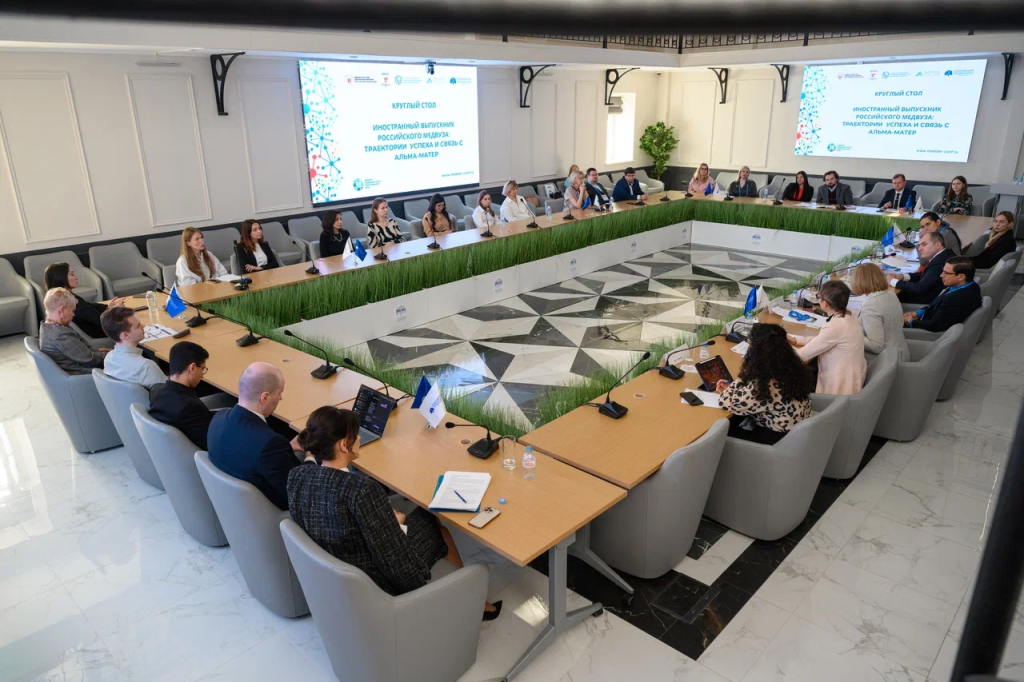
The discussion was opened by Mikhail Brovko, Vice-Rector for International Affairs at Sechenov University. He emphasized that the mission of a modern university goes far beyond the transfer of knowledge.
“We need to manage the entire life path of an international specialist – from the moment they first show interest in Russia to the moment they become part of our economy and society. The university must become a centre for human capital development and talent pool formation”, said Mikhail Brovko.
The Vice-Rector also outlined the profile of a successful international graduate as seen by Sechenov University: a professional integrated into Russian society, fluent in Russian, possessing deep professional skills, high scientific potential, and leadership qualities.
The global goal of the university is to educate specialists ready to build their future in Russia. For this purpose, a model of systematic support has been developed, covering the full cycle – from recruitment that takes into account the foreign policy agenda and talent search through Olympiads, to graduate employment. A special role was noted for the preparatory department, where not only language skills but also primary loyalty to the country are fostered.
Zalim Balkizov, Secretary General of the ROSMEDOBR Association, shared specific parameters for measuring the success of international graduates. Olga Radayeva, Director of the Centre for Priority Educational Programmes at Ogarev Mordovia State University, used the example of India to discuss how to build career guidance programmes for international applicants. Svetlana Galizhanova, a specialist from Sechenov University, noted that analysing the academic gap is a key factor for initial success.
Anastasia Shatilina, representing the Moscow Department of Entrepreneurship and Innovative Development, introduced participants to the opportunities of services for integrating international talent into Moscow’s economy. Irina Karelina, Vice-President of HSE University, focused on tools to enhance the competitiveness of Russian higher education.
“We had an honest, professional dialogue. A wonderful impetus for finding and testing new ideas!” noted Irina Karelina. “Such meetings during Sechenov University’s Medical Education Week are a wonderful annual tradition, a great opportunity to hear different experiences from colleagues, to check complex issues, and to find confirmation that we are on the right track.”
A vivid confirmation of the effectiveness of the discussed approaches came from the success story of Gazaleh Pouya, a graduate of Sechenov University and a pharmacist. She now works as a laboratory assistant at the Pharma-Premium Research and Education Centre. Gazaleh shared how, while on holiday in Moscow, she fell in love with the city, enrolled in the preparatory faculty, and then into the Institute of Pharmacy named after A.P. Nelyubin. Active participation in scientific circles and conferences, an internship at R-Pharm, a red diploma, and the medal “To the Successful One” – these are the components of her success.
“Sechenov University has become my second home. I feel support here and see opportunities for my development. I want to help international students study in Russia independently and confidently”, Gazaleh shared her plans.
Kimia Faridi, a 4th-year student at the Institute of International Education of Sechenov University, thanked the organisers for the opportunity to hear the experts and confirmed that Russia is a land of boundless opportunities for talented youth.
The roundtable gave rise to new ideas and reinforced the understanding that systematic work with international students at all stages – from applicant to established professional – is a strategic priority that builds a talent pool and strengthens the position of Russian medicine in the world.